
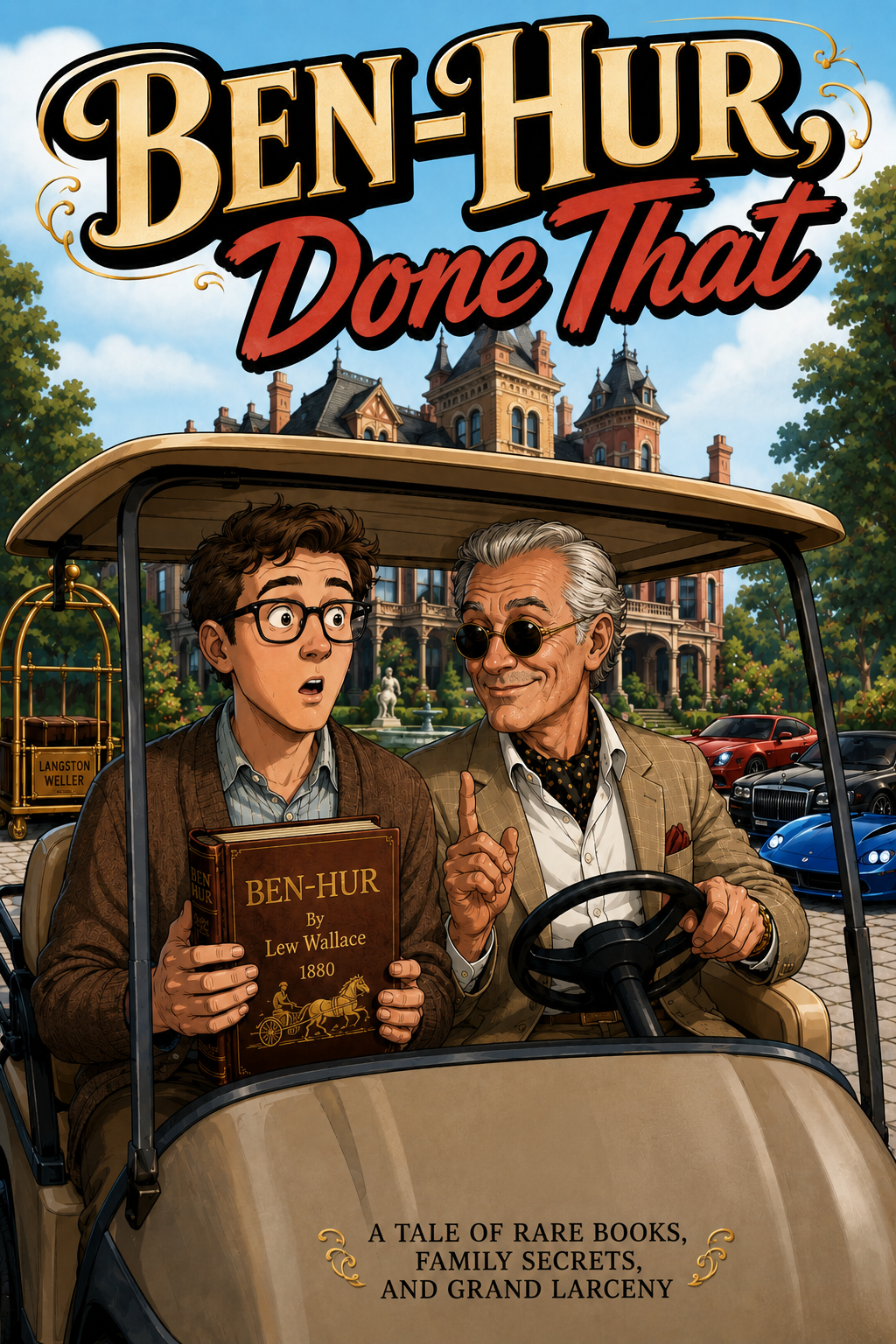
A Rare Book. A Dying Wish. One Very Bad Decision.
Milo Galbreath has spent his entire career surrounded by books. As the quiet librarian of a small-town library, he knows that every volume has a story, and sometimes the story behind the book is even more valuable than the words on its pages.When an elderly woman accidentally donates an exceptionally rare first edition of Ben-Hur, personally inscribed by author Lew Wallace to "the wife of my youth," Milo believes his only job is to safeguard the treasure until it can be returned. Then he meets the woman's charming, eccentric brother, Langston Weller.Langston has another idea.What begins as a simple act of honesty quickly becomes an irresistible adventure involving rare books, family secrets, million-dollar temptations, and a scheme so outrageous it just might work. Along the way, Milo discovers that integrity can be surprisingly complicated when history, inheritance, and opportunity collide.Filled with memorable characters, gentle humor, and unexpected twists, Ben-Hur, Done That is a lighthearted mystery that celebrates the enduring love of books and reminds us that sometimes life's greatest adventures begin with a single page. If you enjoy clever mysteries with heart, wit, and a satisfying surprise, climb aboard and enjoy the ride.
Ben-Hur, Done That
Milo Galbreath had one true love in his life. Well, more accurately, he had thousands. His love was reading. Books were his best friends and constant companions. They provided a world in which Milo could be a king or a pauper, a warrior or a dentist. It was a perfect relationship his vocation supported. Milo was a small-town librarian.
Books allowed him to walk on quiet beaches or ride the backs of dragons. He had recently killed vampires, won a Civil War on a distant planet, and even more impossibly, he had talked to beautiful women. All in his imagination, of course. Books were his life. Especially since his adopted parents had died, leaving him alone in the world.
Milo had always believed Saturday mornings belonged to quiet things like dusty tomes and their accompanying motes drifting through the library’s tall windows. It was a time for the soft thump of returned books sliding into bins, the faint smell of old paper and the feel of a sturdy binding in his hands.
Crime, in his mind, was something that happened in other people’s stories…preferably shelved under Mystery, alphabetized, and returned on time. His love affair with books and the manner he sometimes “acquired“ them wasn’t really a crime as much as it was “rehousing” new friends.
Milo lifted the lid of a donation box, revealing the worn leather spine of Ben-Hur. He felt more than the usual librarian’s curiosity. The moment he opened it, the world tilted. He gently lifter the cover. There, in looping, confident ink, sat Lew Wallace’s signature. Beneath it, a dedication: To the wife of my youth. And on the title page, the unmistakable imprint of Harper and Brothers, 1880. He knew the book was an authentic, first edition.
Milo whispered, “Hello friend. Life is good,” as though the book might hear him. “I’ll bet you have friends that miss you.”
He checked the donation receipt. The donor had listed “misc. attic books.” Milo dialed the number, already bracing for the awkwardness. He had made many such calls over the years as his personal collection of intimates grew.
An elderly sounding man answered on the second ring.
After Milo’s brief explanation for the call, the thin, papery voice replied, “Oh my, thank you so much for catching my silly error, young man,” the owner exclaimed. “I paid a service to clean out my attic. I had forgotten about that book being there. I’m bed‑ridden, you see. It seems I’m on my deathbed…though I’ve spent more time here than I ever expected.”
“I’m sorry to hear that, Mr…” he looked at the scrawled signature on the receipt, “Webber?”
“Weller. Langston Weller. I’ll have someone on my staff pick it up when they return next week. Can you put it somewhere safe until then?”
Milo felt a tug in his chest. “I have your address on the donation paperwork. It would really be no trouble to drop it by on my way home from work.”
“That would be very kind. I’ll watch for you.” The frail voice was gone as the phone clicked in Milo’s ear. He smiled and held the leather-bound jewel to his chest. Four o’clock couldn’t arrive soon enough.
He set the phone back in its cradle, leaned back in the chair and closed his eyes, smelling the old pages of the book. Returning it seemed simple enough, but the address was in a part of town Milo had only seen in glossy magazines…where houses had names engraved over stone archways and rod-iron gates. Milo had been to dozens of homes over his years of collecting rare books, but never to the rarified air of Bronson Estates on the north side of town.
By four-thirty, Milo was steering his Prius through a neighborhood that looked like it had been built by people who had never once worried about rent. The mansion was a newly constructed home built with Victorian ambition. It had three floors, tall gables and a turret on one corner like a guard tower. Milo whistled under his breath. Lush gardens spilled over stone borders. Three exotic cars gleamed in the circular drive like lounging jungle cats. A golf cart sat under the portico, seeming to be strangely out of place.
He parked beside it, stepped toward the door, and reached for the bell. Before he touched it, a buzz and click sounded. Cameras blinked awake overhead.
“Please, come in, young man,” said the elderly voice from a small speaker.
Milo entered cautiously. The interior was a museum of wealth…marble floors softened by Turkish rugs. Paintings adorned the wood-paneled walls. Lighting came from large windows and antique brass sconces.
The man who appeared at the top of the staircase did not fit the frail voice Milo had heard. “I can’t thank you enough for bringing her back to me,” he said. His voice was much stronger than before.
Milo blinked up at him. “I’ll bring it right up.”
“Nonsense.” He was fit, trim, maybe sixty, or slightly younger, judging by the way he descended the stairs. Quick, sure-footed, almost jaunty. The man reached the bottom with a final confident step. He saw Milo’s expression and grinned. “I’m feeling much better.”
He extended a hand. “I’m Langston Weller.”
Milo handed over the book. Weller tucked it under his arm with casual reverence, then shook Milo’s hand. Milo still hadn’t found his voice.
Weller chuckled. “I can tell you have questions.”
“Well… you sounded…”
“Like a ghost on the telephone? Yes. I enjoy a bit of theatrics.” He tapped the book. “This beauty deserved a dramatic reunion.”
Milo stared. “You’re not bedridden.”
“Not even close. I was, briefly, last month. Then I realized lying around waiting for death was terribly boring. So I got up.” He gestured toward the door. “Come on. Let’s go for a ride, and I’ll explain everything.”
“A ride?”
“Yes. In the golf cart. It’s the only vehicle my doctor allows me to drive unsupervised. Something about ‘limiting the radius of potential chaos.'”
Milo hesitated. “Is this… safe?”
“Absolutely not,” Weller said cheerfully. “But it’ll be fun.”
They stepped outside. Weller climbed into the cart with the enthusiasm of a teenager stealing his parents’ keys. Milo sat beside him, clutching the seat.
Weller started the cart. It lurched forward quietly as the electric motor engaged, responding to Weller’s heavy foot.
As they rolled down the cobblestone drive, Weller said, “You see, young man, may I call you Milo?”
Milo couldn’t recall telling the man his name. But he must have. “Sure. Yes, of course. I’m uh…Milo Galbreath.”
“I’m aware. We have much to discuss, Milo. You see, when you spend your life collecting rare things, you eventually realize the rarest thing of all is a good story. And you’ve just walked into mine.”
Milo swallowed hard. “Collecting? Am I… in danger?”
“Not yet,” Weller said, smiling at the road ahead. “But give it time. Mysteries always take a few chapters to warm up.”
Milo looked at the leather book he had returned, now resting in a basket on the front of the golf cart as they bounced across the cobblestone walkway, then onto a smoother concrete walk they wound their way toward the back of the property.
“You don’t seem unhealthy at all, Mr. Weller. You came down those stairs faster than I take them at the library.”
“More theatrics, I’m afraid. All quite necessary. One does what one must do when building a legacy. Just as I have built all of this,” he said, pointing at their surroundings.
“You built all this?” Milo asked.
“I paid for it.”
“That wasn’t my question.”
Langston smiled. “You are a librarian.”
“What does that mean?”
“You notice wording.”
The cart passed behind the house, where the property opened into several acres of gardens. A narrow stream wound beneath a stone bridge. Farther back stood a glass greenhouse and a guesthouse that would have dwarfed Milo’s apartment building.
Langston slowed beside a pond.
“The book was never mine,” he said.
Milo looked at the volume in the basket. “You told me you forgot it was in your attic.”
“I sometimes tell lies.”
“That much I figured out when you sprinted down the staircase.”
“I prefer glided to sprinted. Words matter to me, too.”
“OK. Glided. Swept. Not the least bit frail or infirm.”
Langston rested one hand on the steering wheel. “The book belonged to a man named Whitcomb. He lives three streets from here. Owns several oil-field service companies, two private aircraft and a collection of rare books he understands about as well as I understand modern poetry.”
Milo stared at him. “You bought it?”
“I acquired it.”
“I don’t understand. Do you mean that you stole it?”
“Acquired is a more elegant word.”
“With all of this,” Milo looked around, “You have enough wealth to purchase a book like that. Its value can’t be more than a few thousand dollars. That’s a lot for me on a librarian’s salary, but not for someone like you. I don’t understand.”
Langston laughed softly and drove on. “You shall, young man. It will all be made clear.”
Milo looked back toward the mansion. “Why put it in a library donation box?”
“Because I needed to know what you would do.”
“With a stolen book?”
“With an extraordinarily valuable stolen book.”
Milo’s throat tightened. “You were testing me.”
“I was introducing myself.”
“To me. To a librarian?”
“To my son.”
The cart continued moving, but Milo felt as if the world had stopped.
He turned slowly. “What did you say?”
Langston brought the cart to a halt beneath an enormous pecan tree. Sunlight flickered through the leaves and moved across his face.
“Your mother’s name was Inga Green,” he said.
“My mother’s name is April Galbreath.”
“She was the lovely woman who, with Dale Galbreath, adopted you.”
“How do you…?”
“Allow me to explain. But the story is mine to tell, so enjoy it as the chapters are revealed. Don’t look ahead, just yet. Your biological mother, the beautiful and charming Inga, had dark-brown hair, green eyes and a laugh that made strangers take notice of her. She was twenty-four when I met her. I was twenty-eight and already a thief.”
Milo said nothing.
“I had broken into an estate outside Boston,” Langston continued. “The owner was supposed to be in Europe. Inga was the owner’s assistant. She came back for a folder she had forgotten and found me standing in the library with a silver candelabrum under one arm.”
“That sounds like the beginning of a bad romance novel.”
“It was worse. I dropped the candelabrum on my foot.”
Despite himself, Milo smiled.
“She should have called the police. Instead, she asked why I had ignored the Degas hanging six feet away.”
“What did you tell her?”
“That it was a reproduction.”
“Was it?”
“No. I couldn’t carry both. I had a buyer for the gold.”
Milo looked across the pond. “You expect me to believe this?”
“No. Not yet.”
Langston reached inside his jacket and removed a worn photograph. He handed it over.
A young woman stood beside a much younger Langston in front of a carnival ride. Her hair blew across her face, and she appeared to be laughing at whoever held the camera.
Milo studied her eyes.
He had seen them every morning of his life in the mirror.
“Inga knew what I was,” Langston said. “She believed I could stop. I believed that too, whenever she was in the room.”
“What happened?”
“I was arrested in Chicago. Burglary, possession of stolen property and several other charges that sounded far less romantic when read aloud by a judge. I went to prison. Inga was pregnant, though neither of us knew it when I was taken away.”
Milo’s fingers tightened around the photograph.
“She died during childbirth,” Langston continued. “There was no father listed. No relatives came forward. You entered foster care and were adopted seven months later by Dale and April Galbreath.”
Milo looked at him sharply. “How do you know their names?”
“I have always known, since my release from Illinois Corrections when you were six years old. It took a bit of research to track you down, but breaking into the office of the Attorney General made it possible. That was the first time I stole information only. It was exhilarating.”
“Sounds risky?”
“It was worth the risk. Once I discovered Inga had expired giving birth and the date on her grave marker, I knew the child must be mine. We were committed to one another before I was committed to the state of Illinois.”
“So, you have known who and where I was since I was six and you’ve waited twenty-two years to say anything?”
“I’ve been busy. You had a family. I couldn’t justify interrupting your life.”
“You’ve known where I was my entire life? You watched me grow up?”
“Yes. From a distance. I never made contact with your adopted parents.”
“Birthdays? School? College?”
“Yes. All of it. I have even been inside your library on several occasions. I’ve been aware of you and your, more creative endeavors for some time now. Your…acquisitions, shall we say. And at your most difficult times. I was at Greenlawn last year.”
“My parents’ funeral?”
Langston’s expression changed. “Yes. Not close, but close enough.”
Milo thrust the photograph back at him. “You could have come to me.”
“I was a convicted thief with no legal claim and nothing decent to offer.”
“You seem to have done all right.”
“All of this came later.”
Milo looked toward the mansion. “From stealing.”
“Mostly. Some wise investments too, of course. But my own acquisition efforts made it all possible.”
“Is that supposed to make me feel better?”
“No. It isn’t my intent to make you feel one way or another about the life I have led. Only about what lay ahead.”
The cart remained beneath the tree. Somewhere across the property, a sprinkler clicked rhythmically.
Langston returned the photograph to his pocket.
“A month ago, I opened a safe in a house in Preston Hollow,” he said. “There was no cash. No jewelry. Nothing easily sold and only signed first editions. Twain. Dickens. Doyle. Wallace.”
“Whitcomb’s collection?”
“A portion of it.”
“You carried his collectible books out of his house?”
“I took six.”
“That must have been disappointing.”
“It was illuminating. I had gone looking for diamonds and found the one thing that might lead me to you.”
“So you planted Ben-Hur in the donation box.”
“I delivered it, along with enough ordinary books to make the mistake believable. The receipt contained my address.”
“You knew I would recognize it.”
“I hoped you would. I’ve been there to see that you are the one who handles all the donations. I’ve seen the look on your face when you pull something extraordinary from a box.”
“And what if I had put it into circulation?”
“I would have been quite surprised and disappointed. But I have five others to use as lures had the Wallace failed.”
Milo gave him a cold look. “You thought dishonesty was genetic?”
“No. I thought curiosity might be.”
Langston started the cart again. They followed the pond toward the greenhouse.
“There is more than one reason for my overture at this time. Of course, I want to get to know my son.” He could see the look on Milo’s face and knew that title was unearned. “I know this is hard to accept. But you knew you were adopted, so you had to know, or at least have been curious, that somewhere there existed someone like me.”
“My parents told me about my biological mother, of course. When I was twelve, but there was never any mention of who my father might be. Why now? Why wait this long and why not just keep it to yourself? Leave me alone completely?”
“My doctor says I have familial hypercholesterolemia,” he said. “It’s an inherited condition. My father died of a heart attack at fifty-eight. His brother died at fifty-one. I have been fortunate, but fortune eventually runs out.”
Milo glanced at him. “You wanted to warn me.”
“I wanted you tested. Diet, medication and exercise can reduce the risk if you know what you are dealing with.”
“You could have sent a letter.”
“I wrote seven. Eventually I burned them all and decided it best to meet you face-to-face.”
“It’s selfish. You had no idea how this meeting might affect me. What if I was fragile or suicidal? What if such a stressful situation put me over the edge?”
“I know you’re a dreamer. You’re a voracious reader and, shall we say, a collector.”
Milo looked at Weller, not knowing how to respond to that. Clearly this man knew a lot about Milo. A man Milo could not recall ever seeing.
They passed the greenhouse. Inside, white orchids filled long tables. Langston slowed again.
“I also need help,” he said.
Milo gave a humorless laugh. “There it is.”
“There what is?”
“The real reason.”
“The health warning is real.”
“But so is the recruitment pitch.”
Langston looked almost pleased. “You do notice structure.”
“What kind of help?”
“The kind provided by a man who understands provenance, editions, signatures and private collections. Wealthy people catalog their books poorly. They insure paintings, diamonds and watches, but they leave fortunes gathering dust on shelves.”
“You want me to identify books for you to steal.”
“I want a partner. I’m looking for help in the family business. It’s only natural that a father want to pass down a legacy to his progeny.”
“Nothing about this is natural. And I’m a librarian. Not a thief.”
“Don’t be coy. You are most certainly a thief. The sign out front of your building doesn’t say Milo’s Books. Even donated mistakes are city property.”
Milo turned toward him. “What is it you think you know about me, Mr. Weller?”
Langston stopped the cart beside a line of cedar trees.
“Three years ago,” he said, “the library received the estate of Judge Clarence Bell. The inventory listed a signed first edition of The Maltese Falcon. It never reached the catalog.”
Milo’s face went still.
“Two years ago, the Brenner family donated twelve boxes after their mother died. One contained a first edition of Rebecca, signed by Daphne du Maurier. It also disappeared.”
“You’ve been investigating me?”
“I have been admiring you. And there isn’t a lock I cannot pick, a window I cannot open, and certainly not a sliding patio door I cannot enter. You keep The Maltese Falcon on a bookcase you made in shop class in ninth grade. It has your initials scratched under the second shelf.”
“You’ve been in my apartment?” Milo was incensed. “Why would you bother with a place like mine? I’m not wealthy by any stretch of the imagination.”
“That may all change soon.”
“I want nothing to do with a life of crime, Mr. Weller,” Milo said emphatically.
“Please call me, Father.” Weller teased. “I know this is a lot to take in.”
“That’s putting it mildly. Father isn’t a term you earned by your own mistaken donation.”
“Well, don’t hold back on my account. Milo, son, I don’t mean to make light of what I know must be devastating news for you. But, it isn’t bad news at all. You had to have wondered, at least at one time, who your father was. Now you know. You lost the dear people who were kind enough to raise you almost a year ago. That loss and loneliness are difficult at any age. Now you have something that can fill that void.”
Milo turned in his seat. “If you think for a minute that you can replace my…”
“Not me, Milo. The books. The rare, beautifully bound, exquisitely produced books. I’ve read your writings, Milo. I know how the worlds that appear on page are your place of escape.”
“You read my journal?”
“Well, in fairness, you did leave it bookmarked.”
“In a locked desk drawer!”
“Let’s not quibble.”
“What is it you want from me? I have no intention of climbing through second-story windows or breaking into government offices. That’s not me. I don’t care who you are.”
“Milo, you noticed what no one else noticed. You have removed items whose owners did not understand their value.”
Milo stared ahead through the cedars.
“How many?” Langston asked. “I saw a dozen at your place. But I also saw a receipt for a safety deposit box.”
Milo did not answer.
“More than a dozen, surely.”
Milo looked at him. “Thirty-one.”
Langston’s eyebrows rose. “Almost thirty-two if we count Ben-Hur.”
Milo answered. “Apparently we don’t.”
For the first time, Langston seemed genuinely surprised.
Milo leaned back against the seat. “Estate cleanouts arrive every month. Families keep what looks valuable and donate the rest. They miss inscriptions, printing errors, bindings and publisher marks. The library sells most donated books for a dollar. Sometimes fifty cents. Some are shipped to smaller libraries, donated to school systems, and sadly, some are even destroyed.”
“So you rescued them.”
“That was the word I used.”
“Acquired is more elegant.”
Milo laughed once. “I suppose it is.”
Langston’s smile faded as quickly as it appeared. “Why did you call me? I intended to wait a couple of days, then call you to inquire about it. To see how you handled the pressure. I was a bit surprised when you called.”
Milo looked down at the copy of Ben-Hur.
“I wanted to know whether there were more.”
“At my house?”
“In the attic. In boxes. Wherever your cleaning service found this one, I thought I might offer to help sort them.”
“And adopt anything that appeared neglected.”
“Something like that.”
Langston nodded slowly. “I was afraid you might be honest.”
“I was afraid you might actually be dying.”
“That part remains unsettled.”
Milo glanced at him.
Langston placed both hands on the wheel. “I’m not asking you to become violent. I have never carried a weapon. I never enter occupied homes. I resist stealing sentimental objects. I target people who own more than they can remember and insure more than they can appreciate.”
“That’s still theft.”
“Yes. But it’s practically harmless. People who have no idea what they have scarcely feel the loss. I, on the other hand, appreciate the true value of my new possessions. Until I fence them for forty cents on the dollar.”
Milo watched the orchids through the greenhouse windows. For years, he had told himself the books deserved better. He gave them climate-controlled shelves, protective covers and a home where they would be read by someone who understood them.
He had never sold one.
That fact had allowed him to believe he was different from a thief.
Beside him sat the proof that the distinction was thinner than tissue paper.
“What happens if I say no?” Milo asked.
“I give you your medical history, the name of a specialist and copies of everything I know about your mother. Then I return you to your car.”
“And the books in my possession?”
“They remain our secret.”
“Why?”
Langston’s voice softened. “Because I have already missed too much of your life.”
Milo looked at him for a long moment.
“What happens if I say yes?”
Langston glanced toward the mansion.
“I show you a library owned by a man who believes his collection is worth $40,000.”
“And what is it actually worth?”
“Closer to two million.”
Milo felt the familiar pull in his chest. Not greed exactly. Something more intimate. The thrill of discovering value hidden beneath neglect. The pleasure of knowing what others had failed to see.
“Would we steal all of it?” he asked.
Langston smiled. “I knew you couldn’t resist.”
“No,” Milo said quickly. “I’m asking for context.”
“Of course.”
“I haven’t agreed to anything.”
“Certainly not.” The smile remained.
“And before we discuss another book, I want the medical records. I want proof about my mother and your relationship with her. More than a photo taken at a carnival. I want legal documents.”
“All waiting inside.”
“And I drive my own car.”
“To the job?”
“To dinner.”
Langston blinked. “Dinner?”
“You don’t get to appear after twenty-eight years, announce that you’re my father and take me directly to a burglary.”
“I thought the transition might be smoother.”
“It needs a meal in the middle.”
Langston considered this, then nodded. “There is an excellent steakhouse nearby.”
“I’m a vegetarian.”
The old thief stared at him. “Since when? You had burger wrappers in your waste bin at home.”
Milo smiled. “Lifestyle changes. I didn’t know about the genetics until now.”
Langston began to laugh. The sound rolled across the garden, loud and unguarded.
Milo reached into the basket and lifted Ben-Hur.
“To the wife of my youth,” he read.
“I thought the parallel fitting,” Langston said. “What do you plan to do with that?”
Milo looked at the valuable old book, held it to his chest and breathed in the warm air as they approached the front drive. “I’m taking it. I have a special place on my shelf for it.”
“You think you can claim my book for yourself just because you’re my son?”
Milo nodded his head. “Ben-Hur, done that.”
.
Building Bridges
COMING SUMMER 2027
THE ASHFORDS OF BOONE COUNTY