
Weird Science
Wallingford Heights Mysteries • Book One
AVAILABLE NOW
Welcome to Wallingford Heights, where curious discoveries, hidden truths, and small-town mysteries collide. What begins as an unusual event soon uncovers secrets that have been buried for years, changing the lives of everyone involved.
ABOUT THE BOOK
Weird Science introduces readers to Wallingford Heights, a town where history and mystery go hand in hand. Strange events, unexpected discoveries, and long-forgotten secrets set the stage for a series that spans generations.
As the first installment in this series, readers are introduced to The Hair Raisers: three hairdressers and a seamstress whose attention to detail and sense of justice won’t let them accept status quo.
THE WALLINGFORD HEIGHTS STORY
1893
A growing town begins its story.
Strange Discovery
An unusual event changes everything.
Hidden Secrets
The past refuses to stay buried.
Small-Town Mystery
Every clue leads to another question.
The Beginning
The first mystery starts here.
THE RESEARCH BEHIND THE STORY

SMALL-TOWN MYSTERY
HISTORICAL SETTING

STRANGE DISCOVERIES

HIDDEN CLUES

THE FIRST ADVENTURE
MEMORABLE CHARACTERS
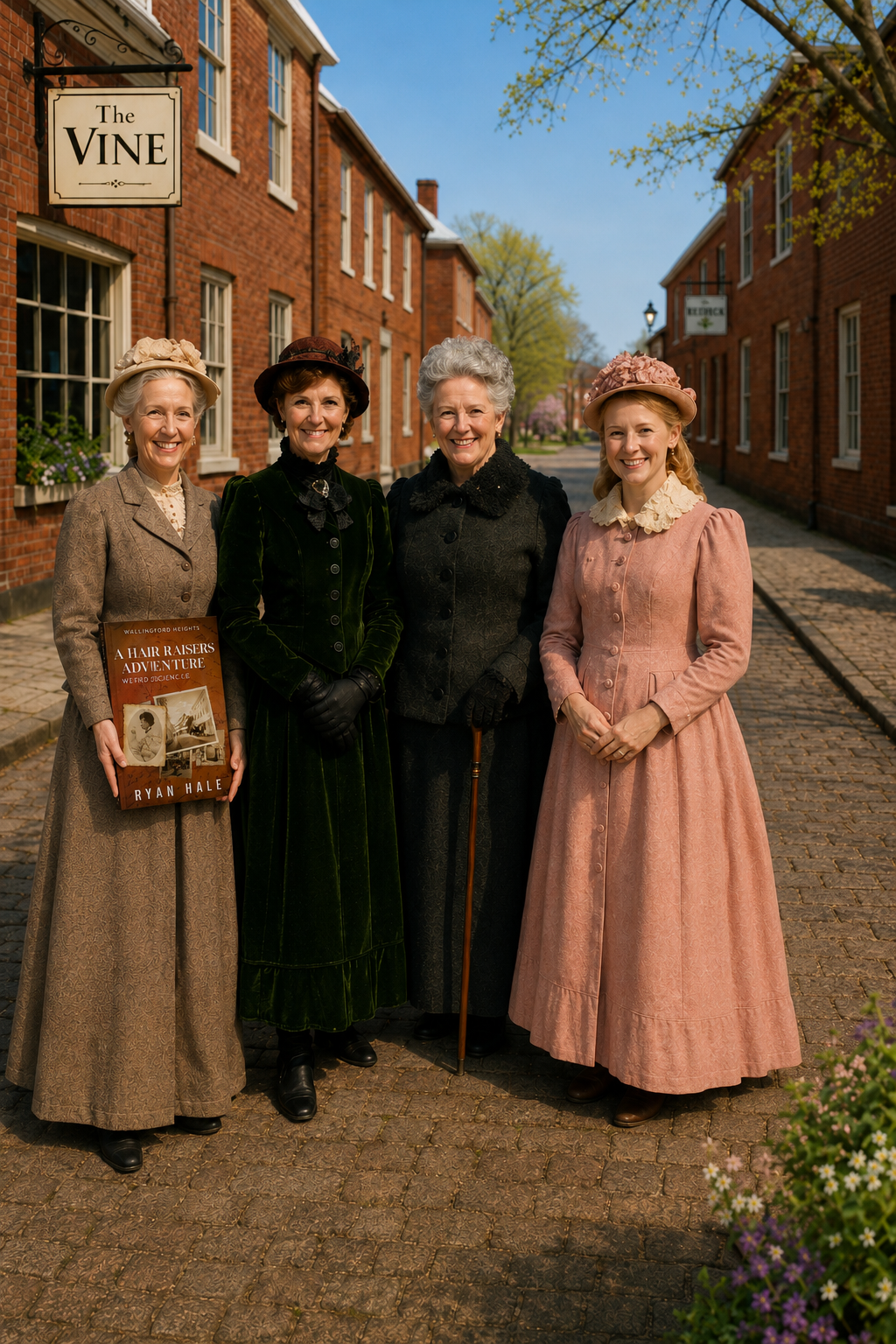
66 Estelle, Marilou, Chasity and Clara: four strong women who pay attention and work for women’s rights.99
Prolog
Tuesday, November 3, 1896
Elias H. Whitaker prided himself on his small but significant role in Wallingford Heights. As the town’s barber for over thirty years, his shop had seen generations of men pass through its doors. As one of the town’s councilmen, he reluctantly wielded political sway that helped his thriving barbershop.
Handling scissors, combs, and straight razors brought Elias his greatest joy. The day’s politics meant little and brought no joy to his life.
He was finishing another long day of cutting hair, trimming beards, and applying pomade to the receding hairlines of the town’s men. His movements were methodical as he swept the floor, emptied the ash bin, and gathered up the soiled towels, his routine as familiar as the back of his hand.
Stepping into the cold November evening air, he carried the trash to a burn can in the alley behind the barbershop. He turned his collar up to the snow beginning to fall and rubbed the nose of Sadie, his horse, waiting for the gentle ride home.
“It won’t be long now, old girl. I’m about ready to go. I’ll get my coat and hat, and we’ll get you back to the barn in no time.”
The horse whinnied in response, a vapor cloud puffing into the cold night air. The only sound in the darkened alley behind the barbershop was her whinny and a clomp of a patient hoof in the dirt. The night was quiet, the quiet that settled over a small town after dusk. As Elias dumped the bin, he heard the faint jingle of the bell over his shop’s front door. He paused, a frown creasing his forehead. His CLOSED sign was displayed. Annoyance prickled at him as he headed back through the rear door.
“Can’t you read the sign? I’m closed for the night. You’ll need to come back tomorrow,” he called out as he entered the main shop space through the green curtain at the back. Darkness and silence greeted him. The shop appeared empty, the single bulb above his chair now off, and the chain swinging slowly from side to side. He sighed, shaking his head. “Those damned Edisons burn up too fast,” he muttered to himself.
He walked over to set the ash bin in front of his chair, but something caught his eye. His razor jar was tipped over, and the rubbing alcohol spilled across the countertop and onto the floor. The straight razor was missing. A frown deepened the lines on his face.
“Now, where did that go?” he mused aloud. He looked on the floor for his trusty razor but saw nothing.
The faint creak of the floor behind him sent a chill down his spine. He turned, and a flash of light caught his eye—the gleam of the razor in its downward stroke. Pain exploded in his neck as the blade severed his carotid artery, larynx, and jugular in one swift motion. His hands instinctively flew to the wound, but no scream escaped his lips. The world around him blurred as darkness closed in.
Elias crumpled to the floor, the life seeping out of him with alarming speed. The warmth of his barbershop—the scent of bay rum, the glint of moonlight on polished scissors—slipped away as a sharp, cold finality set in. Elias’s vision began to darken, and with it came the terrible truth: he recognized the one who had done this. That face and hand with the blade wasn’t a stranger’s. He knew them. He searched his fading thoughts for an explanation, but it slipped through his grasp like smoke. And then the shadows took him.
The barbershop, usually a place of camaraderie and conversation, was now eerily silent. Elias’s body lay still, a stark reminder of the violence that had intruded upon this quiet night in Wallingford Heights. The door to the shop swung gently closed on its hinges, the bell tinkling faintly as if mourning the loss of the man who had breathed life into this place.
The killer walked calmly but purposefully down the newly poured concrete sidewalks facing the businesses on Main Street. Each step was measured, the cadence steady and unhurried. A blood-splattered leather apron was removed and placed in a burn can in the next alleyway.
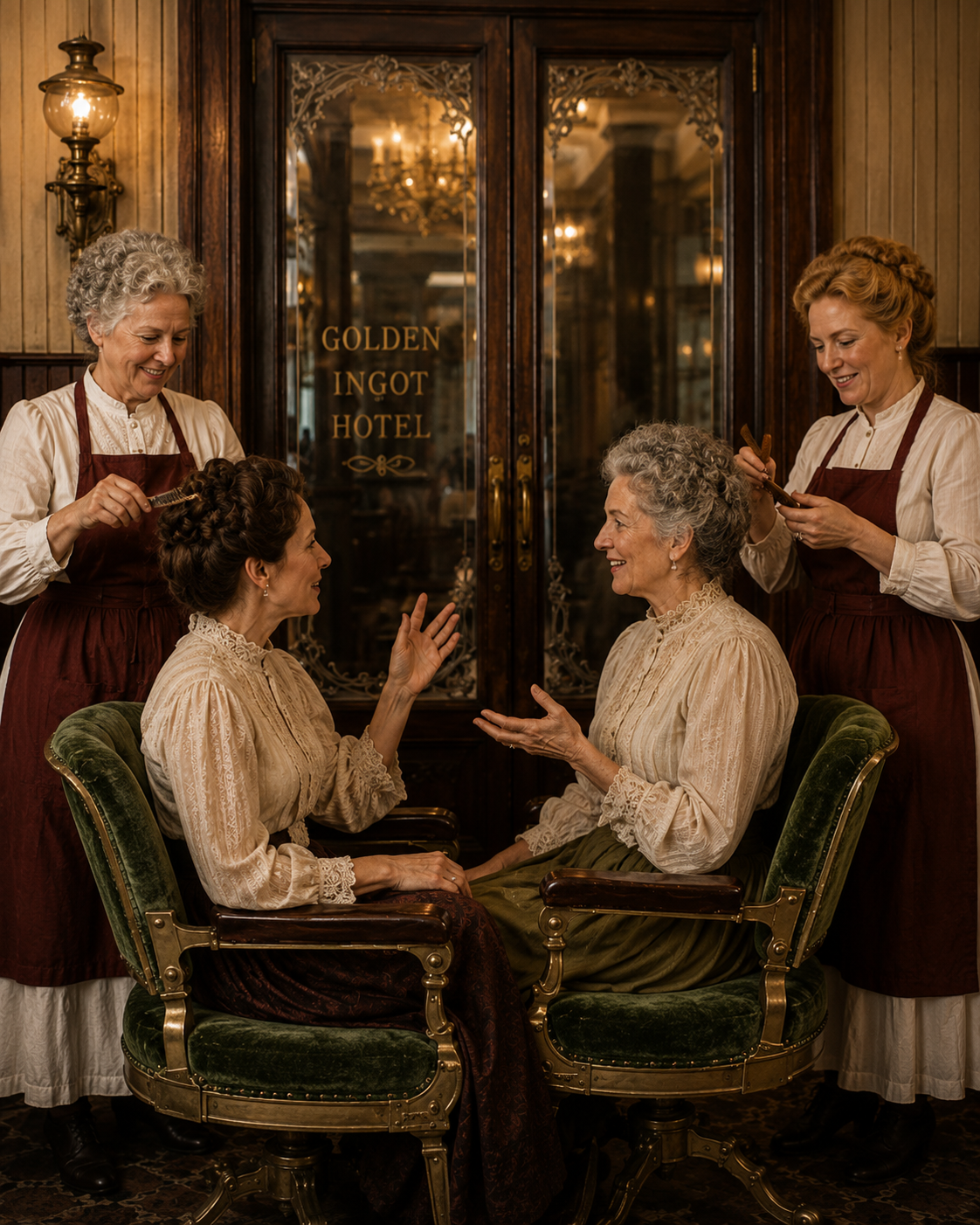
Crossing to the other side of the street, the killer entered the Golden Ingot Hotel lobby and joined the festivities in full swing there.
The lobby was a sea of elegantly dressed men and women, their laughter and conversation mingling with the strains of a string quartet playing in the ballroom. Governor Walcott’s win was a cause for celebration among the Progressive Party. None were more excited than the guests enjoying the festivities that night. Spirits were high, smiles were easy, and optimism was in fashion for one night. The clanking of champagne glasses toasts to bright futures and effusive discussions beneath the crystal chandeliers made the night more special than the election outcome itself.
Mayor Dalton Hoskins, the former prosecutor and local head of the Progressive Party, stood near the center of the room, commanding attention. He was a tall man with a square jaw and piercing blue eyes who had seen both the best and worst of humanity. Beside him was judge Barnabas Bender and his wife, Marilou.
Constable Leland Daily, his stout frame uncomfortably encased in a blue dress uniform, stood chatting with Deputy Constable Myles Cole and his wife of thirty-eight years, Estelle.
“This is the first time I’ve seen you in your dress blues in more than a year, Leland. I must say you are quite fetching”. Estelle smiled mischievously at her husband.
“You don’t have to say that, Estelle. I know I look about as comfortable as I feel. This hat used to fit – I’m sure of it.” Leland laughed and pressed the hat under his arm, looking around at the ballroom full of men and women in their finery.
Leland looked up into the reddening face of his deputy and smiled at his apparent discomfort. “Lucky for us, these grand galas are few and far between, hey, Myles?”
“You got that right, Boss.”
Myles was an imposing figure, a giant man at six feet six and three hundred pounds. His wife, Chasity, a petite woman with a kind smile, stood nearby, engaged in animated conversation with Estelle Daily. Along with Marilou Bender, these three women, members of the Vine Salon, were well known as the Hair Raisers, a name given to them for their knack for getting involved in criminal investigations and their uncanny ability to solve crimes.
“Leland, can you believe the turnout tonight?” Myles rumbled, his deep voice carrying over the conversation. “Governor Walcott’s election has brought the community together. When he took over after Governor Greenhalge died, I was concerned the labor reforms might go by the wayside.”
Leland nodded, his face breaking into a broad smile. “He’s done a fine job of it. I’ll be a more enthusiastic supporter if he can get those public roads to Wallingford Heights. I wouldn’t mind a smooth surface to drive on for a change,”
Mayor Hoskins raised his glass, tapping a spoon against the crystal, drawing the attention of those around him.
“To Governor Walcott and the continued success of the Progressive movement!” he declared, his voice ringing with conviction. “Together, we can build a better future for Massachusetts and our great nation.”
“Hear, hear!” came the response, glasses clinking as the toast echoed throughout the room.
Marilou Bender leaned into Estelle and Chasity, her eyes twinkling with mischief. “You know, I overheard something interesting today at the salon. Apparently, Mr. Thompson from the new bank has been quite taken with the idea of running for city council. Julia, his wife, was positively bursting with the news.”
Estelle raised an eyebrow. “I did hear her talking about that. He certainly has a mind for commerce and has made some important connections. Unseating any of the current members may prove challenging.”
Chasity nodded in agreement. “I’m not as interested in politics as you two ladies are, but Myles seems pleased with our town council and their work with Mayor Hoskins. He says the worst thing a Council can do is butt heads and choke progress.”
“Dissension is a good thing for government. The more voices and opinions, the better, as far as I’m concerned.”
“Marilou, you always like a good argument.” The three laughed together.
“I completely disagree!” Marilou said in response, and they laughed again.
“As far as every voice being heard, I keep holding onto the hope that one day there will be a woman’s voice on Council and in the voting booth.” The three women clinked their champagne glasses again, and in unison, “Hear, hear,” was uttered.
Rayfield Simmons, the owner of the Golden Ingot Hotel, the host venue, was walking around and glad-handing with the other prominent citizens.
“Ladies, can I get you a refill on your bubbly?”
“Are you working this soiree, Rayfe?” “I’m not working, but I recognize the sound of an empty glass being tapped. Many more bottles are in reserve, for which our mayor has already paid. May I?” He offered the bottle and tipped it slowly to refill Estelle and Marilou’s glasses.
“I had hoped Clara would arrive in time for the party. She sent word that she would try.”
“It is such a long drive, Rayfe. I’d feel so much better if she would take the train.”
“She’s doing that on this trip, Estelle. I expected her at 7:30, but, as usual, the 7:30 has set its sights on 8:15.” They laughed at Rayfe’s charming wit but shared concern for Clara.
Clara Simmons, Rayfe Simmons’s younger sister and the fourth Hair Raisers member, was the Founder and Chancellor of Simmons College for Women in Boston. She started the school with an endowment from her brother after gold was found on his property.
The gold strike afforded Rayfe, a retired police detective from New York City, the financial wherewithal to purchase much of downtown Wallingford Heights. He also owned two dozen private residences he rented out, the Golden Ingot Hotel, a new grand hotel under construction, and an apartment structure he was planning near the factory on the outskirts of town.
Simmons College allowed women to earn jurisprudence, nursing, criminal investigation, and business administration degrees. Simmons graduates passed the bar exam and found placement with many of the smaller firms in the Northeast. She hoped that the movement would also move the larger firms.
Bender joined the conversation, his deep voice adding gravitas to the discussion. “I received a telegram from Theodore today. He’s keeping an eye on our election. I think he has his hands full in New York, but with his boundless energy, he still sticks his nose in our business.”
“Now, Barnabas. You know, as Police Commissioner, he is cleaning up that metropolis of murder and mayhem. He’s someone with a future in politics.”
“I’m sure you’re right, Marilou. I could see that in him immediately when he appeared in my courtroom. I hope he remembers our kind accommodations when he moves up in the Party.”
“What’s happened to your memory, old man? You broke your gavel in frustration with Teddy and fought him every step of the way.” Marilou teased.
“Well, I suppose I was a stickler for decorum in those days, I’ll admit that.”
“If by those days you mean today and every day before it, I agree. You insisted we arrive thirty minutes early this evening. Decorum allowed us to watch the staff setting up the room.”
“Oh, fiddle fuddle. There’s no harm in arriving early, old woman.” Barnabas enjoyed the loving banter with his wife of forty years. “Besides, we’ll leave early because I must catch the early coach. The trial in Worcester should take a week at most.”
Marilou held onto Barnabas’ arm as they strolled around the large ballroom. “I hope you’re back before the weather turns, dear.”
“I’ll be back before you know it. The worst of winter is still weeks away. I’d feel it in my bones if it were close.”
The killer, now mingling with the crowd, listened intently. No one around suspected the darkness that lingered beneath the calm exterior. Moving through the throng, the killer observed, analyzed, and gathered information. The celebration provided the perfect cover and opportunity to blend in and disappear.
As the Hair Raisers continued their discussion, the killer remained a silent observer. With its grand ballroom and lively festivities, the Golden Ingot Hotel was the perfect place to stay unnoticed. The chatter of the guests, the clinking of glasses, and the strains of the string quartet created a tapestry of sound that masked any hint of unease.
The ladies separated from their husbands to allow the men to speak more freely. They strolled around the grand ballroom, smiling and greeting the other prominent wives and women enjoying the celebration.
“Margaret Faherty, you look marvelous!”
“Thank you, Estelle. This new frock was necessary to match the new hairstyle you gave me.” They laughed and embraced.
“Well, it suits you, dear.”
“Madeline! How are you, dear?” Madeline Chambers was the wife of an insurance company’s vice president, William Chambers. The Chambers had moved to Wallingford Heights seventeen years earlier and were highly thought of in circles of influence, though more influence seemed always to be pursued.
“Wonderful, thank you. William is in his element tonight. He is gaining support for the next Council seat in next year’s election.”
“So you say. I wish William well. A lot can happen in the next year. Does he have his sights set on a particular seat?”
“He hasn’t said, but any of the three would be suitable. The Wallingford Heights Town Council would be a nice stepping stone for William. He fancies himself as Governor material one day. With Jonathan Callahan getting on in years, it may be time for him to retire. Or perhaps Elias Whitaker, who seems uninterested in important functions such as tonight.” Madeline Chambers looked around as if to draw attention to Elias’s absence.
“Oh, indeed. Well, as I said, good fortune to you both. Barnabas loves his life in public service; we both believe it is a calling one must answer. Enjoy your evening, Maddy.” Marilou strolled on, meeting and glad-handing.
“Thelma! You look marvelous! Is that a new mink stole?” Thelma Clayton, a long-term resident and wife of Zechariah, the President of the Wallingford National Bank, was known to flaunt her wealth. “It is new, Marilou. You have a keen eye. Did I hear Madeline correctly? Her husband has designs on a town council seat?”
“Yes, dear. She thinks William’s going to Washington, D.C., with a temporary stop on the Wallingford Heights Town Council.”
“There is a need for strong fiscal management. Zechariah was considering making a run himself. We have been here considerably longer than the Chambers. Wallingford National Bank has as well.”
“I wish Zechariah well.”
“Hello girls!” A beautiful woman sporting a short brunette bob hairdo and a flowing camel cashmere coat with a fur-trimmed hood stood smiling broadly behind them.
“Clara!” Shouted the chorus of three. Hugs were shared, and cheeks kissed.
“Your brother is around here somewhere and is worried about you.”
“I saw Rayfe in the lobby, Chasity. I’ve already calmed him. You girls have certainly put on your finery! Everyone looks so festive!”
“It is a big night for the Progressive movement, and our men are wearing high cotton, Clara. I do like your new hairdo. It was very bold of you to cut it so short!”
“This style is becoming more commonplace in Boston, Marilou.”
“How are things in Boston?”
“Delightful.” Clara deadpanned. “Challenging as always. We’ve started our second year. This year’s class includes girls from as far away as Oklahoma. Our reputation is growing, and so is our enrollment. Over one hundred young ladies this year!”
“That’s amazing, Clara. The work your school is doing is so important. How is Sophia?”
Sophia Stanton, the first person the Hair Raisers saved from an improper murder conviction three years earlier, was serving as Professor and Dean of the Law School at Simmons College. They continued to work for women’s rights, particularly the right to vote. She was also the granddaughter of Elizabeth Cady Stanton.
“Sophia is doing marvelously! She may soon wed if I’m reading things correctly.”
“That’s exciting. Who’s the lucky man?”
“Jonathan Pendergrass. He’s a law professor at Harvard and is quite the catch by all appearances.”
Mayor Hoskins rose to speak. All eyes turned toward him, silencing a stringed quartet of a cello, two violins, and a harp playing Waltz of the Flowers by Tchaikovsky.
“My dear friends. Lilith and I thank you all for coming tonight. Your continued support means the world to us and our Party’s continuing progress. The time has come to bid you all adieu and goodnight. While I have your rapt attention, as a politician, it is difficult to resist the urge to make a long speech.” Lilith Hoskins stood from her seat next to the mayor. “However, resist it, I shall.” Everyone in the room applauded and laughed. “Goodnight, my friends!”
Among the throngs taking to the street, making their way home on this chilly November night, was a solitary figure with an agenda much different from the rest of the celebrants. The killer moved with a purpose; each step was calculated, and each breath was measured. The night’s events had gone according to plan, but work was still to be done. Walking toward home, two thoughts consumed the twisted mind: getting away with the murder of Elias Whitaker and who must be next to die.